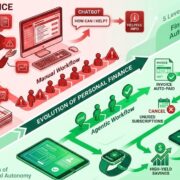

For decades, personal finance has been a chore. We’ve moved from paper ledgers to Excel spreadsheets, and from physical bank branches to mobile apps. But despite these “digital” upgrades, the workload has remained the same: You still have to track the spending, you still have to move the money, and you still have to make the hard decisions.
In 2026, we are entering the era of Agentic Personal Finance. This isn’t just about “chatting” with an AI; it’s about deploying AI Agents that have the authority to act on your behalf.
This guide will explain what Agentic Finance is, how it works, and how you can start building your own autonomous financial ecosystem.
1. What Exactly is “Agentic” Finance?
To understand “Agentic” finance, we first need to distinguish it from the AI we’ve used in the past.
-
Generative AI (The Talker): This is like ChatGPT. You ask it, “How much did I spend on coffee?” and it reads your statement and tells you. It provides information but does nothing else.
-
Agentic AI (The Doer): An AI Agent doesn’t just tell you that you spent too much on coffee. It identifies that you have three unused subscriptions, contacts the companies to cancel them, and moves the saved $40 into your high-yield savings account automatically.
Agentic Finance is the shift from “Software as a Tool” (where you do the work) to “Software as an Employee” (where the AI does the work).
2. The Five Levels of Financial Autonomy
Just like self-driving cars, Agentic Personal Finance exists on a spectrum. Understanding where you are helps you see where you’re going.
Level 1: Manual (The Spreadsheet Era)
You download your CSV files from the bank, categorize them in Excel, and manually pay your bills every month. This is high effort and high error.
Level 2: Automated (The “Rules” Era)
You have standing orders and “Auto-pay” set up. You have a rule that says “Transfer $500 to savings on the 1st of the month.” This is helpful, but “dumb”—if your car breaks down and you don’t have $500, the rule triggers anyway and causes an overdraft.
Level 3: Copilot (The “Assistant” Era)
You use an app that pings you: “Hey, you spent more than usual on dining this week. Should I skip your weekly savings transfer?” The AI suggests, but you still have to press the button.
Level 4: Agentic (The “Delegation” Era)
The AI has “Transactional Authority.” It sees your car repair bill, calculates your remaining cash flow for the month, and decides on its own to pause your savings transfer and move $200 from your “Vacation Fund” to cover the gap. It informs you after the action is taken.
Level 5: Fully Autonomous (The “Invisible” Era)
You no longer interact with a bank app. Your income enters an ecosystem where agents manage taxes, investments, bill negotiations, and daily spending. You only get a “Monthly Health Report” showing your net worth grew.
3. The Core Pillars of an Agentic Ecosystem
How does an AI Agent actually manage your money? It relies on four key “senses.”
A. Real-Time Connectivity (The Eyes)
Agents use Open Banking APIs. This allows the agent to see your balance across five different banks, your credit cards, and your crypto wallets simultaneously. Without this “all-seeing eye,” the agent cannot make smart decisions.
B. Logical Reasoning (The Brain)
Using Large Language Models (LLMs), the agent understands context. It knows the difference between a “one-time hospital bill” (an emergency) and a “one-time luxury watch purchase” (discretionary spending).
C. Transactional Authority (The Hands)
This is the most “Agentic” part. Through secure tokens, the agent can “sign” transactions. It can move money from Account A to Account B or pay a vendor.
D. Verification (The Guardrails)
A good agentic system uses Multi-Agent Orchestration. One agent proposes a move (e.g., “Buy $1,000 of Bitcoin”), and a second “Compliance Agent” checks it against your pre-set risk limits.
4. Real-World Use Cases: Life in 2026
What does this look like in daily life? Here are three scenarios where Agentic Finance changes the game.
Scenario A: The Subscription Hunter
We all have “Subscription Creep”—small $10 charges we forgot about.
-
Old Way: You scroll through your statement, get annoyed, but forget to cancel.
-
Agentic Way: Your agent notices you haven’t opened the “Fitness+ App” in three months. It sends an automated email to their support team, cancels the membership, and notifies you: “I saved you $120/year. I’ve moved the first $10 into your Retirement Fund.”
Scenario B: The Dynamic Budgeter
Standard budgets fail because life is unpredictable.
-
Old Way: You set a $500 grocery budget. You go over it. You feel guilty.
-
Agentic Way: Your agent sees that groceries are more expensive this month due to inflation. It automatically looks for “slack” in other categories. It finds that your electricity bill was lower than expected, so it re-allocates that “win” to cover the grocery “loss” in real-time. No guilt, just balance.
Scenario C: The Optimized Tax-Harvester
-
Old Way: You wait until April to figure out your taxes.
-
Agentic Way: Every time a stock in your portfolio dips, the agent checks if selling it now (Tax-Loss Harvesting) would lower your tax bill. It sells the “loser,” buys a similar asset to keep your portfolio balanced, and banks the tax credit instantly.
5. How to Calculate if Your Agent is Working: XIRR vs. CAGR
When you use agents to move money around constantly, traditional math starts to fail.
If your AI agent moves $50 into a stock on Monday, pulls $20 out on Wednesday, and adds $100 on Friday, you cannot use a simple CAGR (Compounded Annual Growth Rate). CAGR assumes you put money in once and left it.
Instead, Agentic Finance relies heavily on XIRR (Extended Internal Rate of Return).
-
Why? XIRR is designed for “messy” cash flows. It looks at the specific date of every single move your agent made.
-
The Result: XIRR tells you the true annual interest rate your money earned, accounting for the fact that some dollars were only in the market for three days.
6. The Risks: Security and “Black Boxes”
We cannot talk about Agentic Finance without talking about risk. Giving an AI “The Hands” to move your money is terrifying for many.
The “Hallucination” Risk
AI sometimes makes mistakes. It might see a “Refund” and mistake it for “Income.” In an agentic system, a miscalculation could lead to an accidental over-investment or a missed bill.
The Security Risk
If a hacker gains access to your “Agent,” they don’t just see your data—they can move your money. This is why 2026 banking relies on Biometric Intent. Even if an agent wants to move $5,000, the bank might require a quick “FaceID” on your phone to prove a human authorized the agent’s logic.
7. How to Get Started (The Algoy Approach)
You don’t have to go “Full Autonomous” on day one. Here is the recommended roadmap:
-
Audit Your Connectivity: Ensure your banks support Open Banking. If your bank doesn’t have an API, your agent is “blind.”
-
Start with “Read-Only” Agents: Use tools that categorize and suggest, but don’t move money yet. Get used to the AI’s logic.
-
Set “Micro-Authorities”: Give an agent the power to move small amounts (e.g., “Anything under $50”). Use this for “Round-up” savings.
-
Review the XIRR: Every month, check your XIRR. Is the agent actually making you more money than a simple “Buy and Hold” strategy? If the XIRR is lower than the index, your agent is over-trading.
Conclusion
Agentic Personal Finance is the end of “Admin Fatigue.” It turns your finances from a source of stress into a background utility—like electricity or water. You don’t think about how the wires bring power to your house; you just flip the switch.
In the near future, you won’t “manage” your money. You will manage the Agent that manages your money. The skill of the future isn’t accounting; it’s Prompt Engineering your financial destiny.