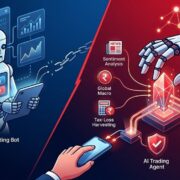

Have you ever wondered how millions of stock market trades happen in the blink of an eye? Welcome to the world of Algorithmic Trading.
In simple terms, “algo trading” is when human traders hand over their decision-making to a computer model. Instead of manually clicking “buy” or “sell,” you set specific rules, and the computer does the heavy lifting automatically.
🤖 Digital Agents: The “Engine” Under the Hood
In the Indian stock market, these software programs act as your digital agents. They connect to the market using Application Programming Interfaces (APIs). These digital agents generally fall into two categories:
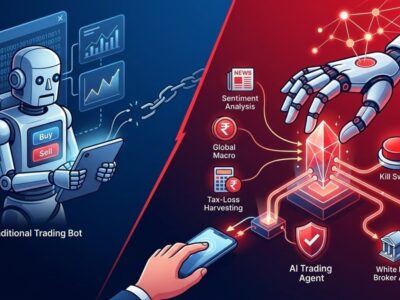
1. White Box (Transparent)
These are completely transparent. The rules, logic, and decision-making processes are open and understandable. You know exactly why the computer made a trade.
2. Black Box (Complex AI)
These are the “Secret Sauce” models. The internal logic is hidden from the user and cannot be easily replicated. Because these agents are so opaque, SEBI requires their creators to:
-
Register as Research Analysts.
-
Maintain highly detailed reports on the software’s behavior.
⚖️ Leveling the Playing Field
In the past, high-speed trading was a “billionaire’s toy.” Large institutions used High-Frequency Trading (HFT) and rented expensive server space right next to the exchange (called Co-location) to get a microsecond head start. This used to cost a lot.
Two game-changing shifts are making the markets fairer:
-
Shared Co-location: Costs for ultra-fast access have been slashed by more than 90%.
-
Free Premium Data: Real-time Tick-by-Tick (TBT) data feeds, which used to be expensive, are now being made accessible to brokers so smaller investors aren’t left in the dark.
👨👩👧👦 Retail Investors Join the Party
As of now, a new framework allows tech-savvy retail investors to participate safely. If you know how to code, you can now write your own personal trading algorithm.
The Rules of Engagement:
-
You must register your algorithm with the stock exchange through your broker.
-
You can use your custom digital agent to trade for yourself and your immediate family (spouse, dependent children, and dependent parents).
🛡️ The “Safety Net”: Keeping the Market Secure
Handing your money to a computer sounds risky, which is why strict “guardrails” are in place to prevent a market crash:
| Feature | How it Protects You |
| Unique ID Tags | Every automated order is stamped with an ID so the exchange can track which algorithm made the trade. |
| The Kill Switch | Exchanges have an emergency “plug-puller.” If an algorithm malfunctions, it is halted instantly. |
| Strict Security | Brokers must use Two-Factor Authentication (2FA) and OAuth to ensure only verified users can access the API. |
The Bottom Line
Algorithmic trading is no longer a sci-fi concept for billionaires; it is becoming an accessible, regulated, and secure tool for the modern Indian investor. By moving from manual “chores” to automated “systems,” you aren’t just trading faster—you’re trading smarter.
Sources and Links for More Information:
-
SEBI: Measures for Strengthening Algorithmic Trading Framework – The official discussion paper on market structural changes.
-
SEBI Circular: Safer Participation of Retail Investors (Feb 2025) – The foundational regulatory framework for retail automation.