
For the last two years, the talk of Wall Street and Dalal Street has been about “Chatbots.” You’ve likely seen tools that can summarize a PDF or write an email.
But in 2026, the world’s biggest investment banks—like JPMorgan Chase, Goldman Sachs, and Morgan Stanley—have moved past “talking” AI. They are now deploying Autonomous AI Fleets.
If a chatbot is a digital librarian, an AI Fleet is a digital task force. Here is how these autonomous systems are changing the high-stakes world of investment banking.
🏗️ What is an “AI Fleet”?
Think of an investment bank like a massive ship. In the old days, every task—checking a contract, analyzing a stock, or spotting a fraudster—required a human “sailor” to do the manual work.
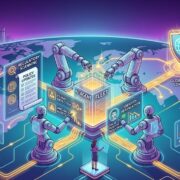
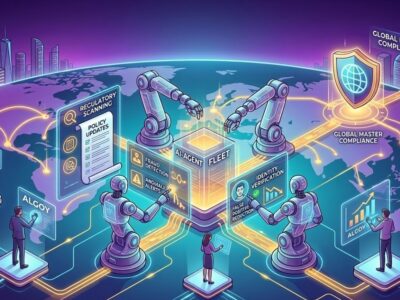
An AI Fleet is a collection of specialized “AI Agents” that work together without needing a human to prompt every single step:
-
Agent A: Monitors global news for a specific industry.
-
Agent B: Sees a news flash and instantly pulls the company’s balance sheet.
-
Agent C: Calculates the risk and drafts a trade proposal.
-
Agent D: Checks the proposal against SEBI or SEC regulations.
Instead of a human doing all four steps, a human now simply sits at the top and clicks “Approve.”
🚀 How Banks are Using Them Today
1. The “Super-Analyst” (Research)
At banks like Morgan Stanley, AI “fleets” digest thousands of pages of research. In the past, an associate would spend 40 hours a week reading earnings transcripts. Now, an AI fleet can “read” every transcript in the sector, compare them to historical data, and highlight the three most important trends in 4 seconds.
2. High-Speed “Risk Patrol” (Compliance)
Compliance is the biggest “chore” in banking. Banks use AI fleets to patrol millions of transactions in real-time. If a trade looks suspicious or violates a new 2026 regulation, the “Compliance Agent” freezes the action and alerts a human instantly. This is “Systems over Chores” at its finest.
3. The “Execution Engine” (Trading)
When banks handle massive orders (like buying 1% of a company), buying all at once causes price spikes. Autonomous Trading Fleets break these orders into thousands of tiny pieces, placing them across different exchanges (like NSE and BSE) at the exact millisecond when the price is lowest.
⚖️ Why This Matters for You
You might think, “I’m not a Wall Street banker, why does this matter?” It matters because these technologies always “trickle down.”
| Feature | The Old Investment Bank | The AI-Driven Bank |
| Speed | Decisions took days or weeks. | Decisions happen in milliseconds. |
| Cost | High fees for “expert” advice. | Lower costs via AI data-crunching. |
| Errors | Human fatigue leads to missed “red flags.” | AI fleets never sleep; they see every detail. |
🛡️ The “Safety Switch”
The biggest worry with “Autonomous Fleets” is: What if the AI goes rogue?
The banks use a “Human-in-the-Loop” system. While the AI fleet does 99% of the heavy lifting, a human must provide the final “Intent.” Think of it like a self-driving car—the car handles the steering and braking, but you tell it where to go and can hit the brakes at any time.
💡 The Algoy Perspective
Maybe the “Agentic Era” is the ultimate equalizer. What was once only available to Goldman Sachs is slowly becoming available to the individual investor. By building your own “mini-fleet” of agents via APIs, you can compete with the giants.
The future of finance isn’t about working harder; it’s about managing a smarter system.
Sources and Further Readings
| Source | Topic / Key Insight | |
| J.P. Morgan Outlook | Promise and Pressure: Positioning for the AI Revolution | |
| Goldman Sachs | The Rise of the Personal Agent & Agent-as-a-Service Economy | |
| Morgan Stanley | AI@MS Debrief & AskResearchGPT: The New Research Frontier | |
| Oliver Wyman | AI Agents in Banking: Reshaping Roles, Skills, and Leadership | |
| Lloyds Banking Group | Enterprise-wide Deployment of Agentic AI in Finance |