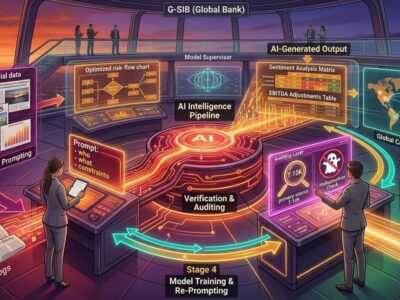

The manual era of junior analysts spending 80-hour weeks scrubbing virtual data rooms for change-of-control clauses is rapidly coming to an end. Generative AI is shifting the analyst’s role from a high-speed reader to a strategic architect who interprets risk rather than just finding it.
The End of the “Data Room Slog”
In our observation, the most grueling part of a junior banker’s life has always been the due diligence phase of an M&A transaction. When two global entities merge, the Virtual Data Room (VDR) can contain upwards of 50,000 documents—ranging from complex derivative contracts to obscure employment agreements in multiple languages. Traditionally, this required a small army of associates to manually flag “red flags.”
Today, the real-world impact of AI in this space is transformative. We aren’t just talking about optical character recognition (OCR) that turns images into text. We are talking about Large Language Models (LLMs) that understand the intent of a legal clause. If a contract in a German subsidiary has a “Change of Control” provision buried in a non-standard paragraph, AI can flag it, translate it, and assess its impact on the deal’s valuation in seconds.
How the Giants are Playing the Game
Major global institutions are no longer waiting for third-party vendors to solve this; they are building internal ecosystems. JPMorgan Chase, for example, has been aggressively rolling out internal LLM tools to help its investment banking division process legal paperwork and earnings transcripts. The goal isn’t to replace the banker, but to ensure the banker isn’t wasting 400 hours on tasks that provide zero intellectual value-add.
Similarly, Goldman Sachs has been vocal about its use of AI to automate the “boring bits” of finance. For a junior analyst, this means your value is no longer tied to how fast you can CTRL+F through a PDF. Your value is now tied to how well you can prompt the AI to find hidden liabilities and how you present those risks to the Managing Director.
Efficiency Analysis: Traditional vs. AI-Augmented Due Diligence
To understand the magnitude of this shift, we have to look at the operational metrics. The following table highlights why the old way of doing business is becoming a competitive liability.
| Factor | Traditional Manual Process | AI-Augmented Process |
|---|---|---|
| Process Speed | Weeks to months (depending on headcount) | Hours for initial sweep; days for refinement |
| Risk/Error Rate | High (Human fatigue leads to missed clauses) | Low (Deterministic patterns ensure 100% coverage) |
| Operational Cost | Expensive (Billable hours of junior/mid-level staff) | Low (Scalable compute costs vs. fixed labor) |
Practical Workflow: How to Use AI as a Career Multiplier
If you are an associate or a junior analyst today, you need to stop viewing AI as a “threat” and start viewing it as your most efficient subordinate. The workflow is shifting toward a “Human-in-the-Loop” model. Here is how top-tier teams are structured now:
- The Ingestion Phase: AI tools ingest the entire VDR. They categorize documents by type, language, and jurisdiction automatically.
- The Semantic Query: Instead of searching for keywords, analysts ask the tool: “Which of these contracts allow for termination if the parent company’s credit rating drops below BBB?”
- The Synthesis: The analyst takes the AI-generated summaries and builds the “Red Flag Report.” The time saved is spent on “Deal Perimeter” strategy—deciding which assets to keep and which to carve out.
The Regional Nuance: EU vs. US
The implementation of these tools varies significantly by region. In the US, the focus is purely on speed and valuation accuracy. In the EU, however, AI tools are being heavily scrutinized through the lens of the AI Act and GDPR. Bankers in London and Frankfurt must ensure that the AI tools they use for due diligence are “permissioned” and do not leak sensitive PII (Personally Identifiable Information) back into a public training model. This has led to a surge in “Private Cloud” AI deployments for cross-border deals.
The Algoy Perspective
The biggest mistake firms are making is assuming that AI implementation is a “plug-and-play” solution. It isn’t. While the technology is powerful, most banks still struggle with messy data silos and legacy document formats that make seamless implementation a nightmare. The real winner here will be the banks that invest in “Data Hygiene” before they invest in “Flashy UI.”
From a strategic standpoint, we expect the “Junior Analyst” role to undergo a massive identity crisis over the next 24 months. If your only skill is formatting PowerPoint decks and reading contracts, you are at risk. However, if you can bridge the gap between financial theory and AI orchestration, you will become the most valuable person in the room. The friction in cross-border M&A—language barriers, regulatory differences, and sheer volume—is exactly where AI thrives. In the future, a “lead” bank won’t be the one with the most analysts, but the one with the most efficient data-processing pipeline.
Sources and Further Reading
For more details on how the world’s largest financial institutions are navigating this technological shift, please consult the official newsrooms of the following organizations:
- JPMorgan Chase Newsroom: https://www.jpmorganchase.com/newsroom
- Goldman Sachs Intelligence: https://www.goldmansachs.com/intelligence/