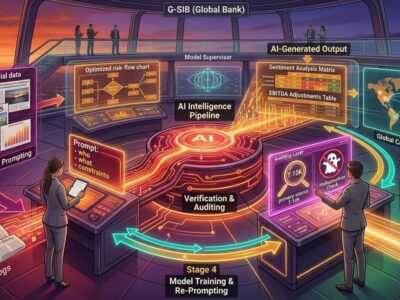

Global financial institutions are rapidly transitioning from rigid, rule-based compliance systems to dynamic AI models that identify illicit patterns in real-time. This shift represents a fundamental change in how junior analysts handle risk, moving away from manual “false positive” clearing toward high-level forensic investigation.
For years, the compliance departments of Global Systemically Important Banks (G-SIBs) like JPMorgan and HSBC have been bogged down by “the 95% problem.” Historically, legacy Anti-Money Laundering (AML) systems have relied on static, linear rules—for example, “flag any transaction over $10,000 to a high-risk jurisdiction.” While these rules are great at catching obvious red flags, they are notoriously bad at context. The result? Roughly 95% of alerts generated are false positives, requiring thousands of junior analysts to spend their days manually clicking through “benign” data.
Today, that paradigm is shifting. The integration of Machine Learning (ML) and Graph Neural Networks (GNNs) is allowing banks to look past individual transactions and start looking at relationships. In our observation, the move toward “AI-First Compliance” isn’t just about efficiency; it is about survival in an era where financial crime is becoming as sophisticated as the banks themselves.
The Move from Linear Rules to Behavioral Graphs
Traditional compliance systems operate on a transactional basis. If a client sends money, the system checks the amount, the sender, and the recipient against a list. If something matches a pre-set rule, an alert is fired. This is “Linear Compliance.”
Modern AI, specifically what we see being deployed at firms like HSBC, utilizes Graph Technology. Instead of looking at a single point of data, the AI maps out entire networks. It looks at how a client is connected to other entities, the velocity of money moving through a series of accounts, and whether those patterns match “known-bad” behaviors—even if the individual transactions stay under the $10,000 threshold.
Key Technical Shifts in AML
- Unsupervised Learning: Unlike traditional systems that need to be told what to look for, unsupervised models can spot “anomalies” that don’t fit any existing rule, potentially catching new types of financial crime before they are even defined by regulators.
- Natural Language Processing (NLP): Banks are using NLP to scan Adverse Media. Instead of a human googling a client’s name, AI scans thousands of global news sources in multiple languages to find negative sentiment or legal troubles in real-time.
- Dynamic Risk Scoring: Rather than a static “Low, Medium, High” risk rating assigned during onboarding, AI allows for a “Perpetual KYC” (Know Your Customer) model where risk scores fluctuate daily based on account activity.
Efficiency Analysis: Traditional vs. AI-Augmented
Understanding the ROI of AI in compliance is essential for any associate trying to justify tech spend to their Managing Director. The following table highlights the operational leap.
| Factor | Traditional Rule-Based Systems | AI-Augmented Compliance |
|---|---|---|
| Process Speed | Manual review of batched alerts (Hours/Days) | Real-time pattern recognition (Milliseconds) |
| Risk/Error Rate | High False Positives (90-95%) | Reduced False Positives by 40-60% via context |
| Operational Cost | High; requires massive “armies” of reviewers | Scalable; shifts focus to high-value forensic work |
| Regulatory Agility | Slow; requires manual rule updates and testing | Fast; models adapt to new data patterns automatically |
What This Means for Your Career
If you are a junior analyst or associate today, the “manual reviewer” role is effectively a dead end. Banks no longer want people who can just follow a checklist. They want “Compliance Technologists.”
The real-world impact is that your daily workflow will shift. Instead of closing 50 low-level alerts a day, you will likely be tasked with investigating 5 high-complexity alerts that the AI has already “triaged” for you. This requires a deeper understanding of how data flows through a bank’s infrastructure. In our view, the most successful professionals in the next five years will be those who can act as the “bridge” between the data science team and the legal/compliance department.
Practical Steps for Associates
- Learn the “Model Logic”: Don’t just use the tools; understand how the features (data points) are weighted in your bank’s AML model.
- Master Data Visualization: Tools like Palantir or internal graph-mapping software are becoming standard. Being able to explain a complex money-laundering web visually to a regulator is a high-value skill.
- Focus on Jurisdictional Nuance: AI is great at patterns, but it often misses “cultural” or “local” business nuances. That is where your human expertise remains indispensable.
The Algoy Perspective
The real winner here will be the institutions that successfully break down their internal data silos. The biggest mistake firms are making is assuming that a powerful AI model can fix a foundation of messy, fragmented data. Most G-SIBs still struggle with the fact that their retail banking data doesn’t “talk” to their investment banking data, creating blind spots that even the best AI can’t see through.
From a strategic standpoint, we believe the industry is moving toward “Collaborative Intelligence.” This is a future where banks won’t just run their own AI models but will share anonymized, encrypted “threat patterns” with each other via Privacy-Enhancing Technologies (PETs). The goal is to create a global immune system for the financial grid. For the ambitious analyst, the message is clear: Stop being a “gatekeeper” of rules and start being an “architect” of risk intelligence. The era of the human rubber stamp is over.
Sources and Further Reading
For those looking to dive deeper into how specific global banks and regulators are handling these shifts, we recommend the following resources:
HSBC News and Media – Updates on Digital Transformation and Compliance
Bloomberg Technology – Global FinTech and AI Regulatory Trends