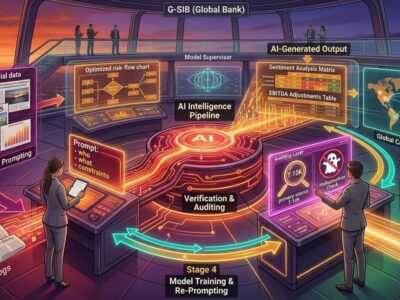

Global wealth management is undergoing a structural shift as Tier-1 banks integrate proprietary Large Language Models to handle the heavy lifting of portfolio analysis and client reporting. This evolution is transforming the junior analyst role from a data aggregator into a prompt engineer and strategic filter for high-net-worth insights.
In the high-stakes world of private banking and wealth management, information asymmetry used to be the primary source of competitive advantage. If you had the fastest analysts to read a 200-page prospectus, you won. Today, that advantage has evaporated. The new frontier is “Model Sovereignty”—the ability of a bank to run its own LLMs (Large Language Models) over its proprietary data to find “alpha” that generic tools like public ChatGPT simply cannot see.
For junior analysts and associates, this isn’t just a technological upgrade; it is a fundamental redesign of your daily workflow. The days of spending twelve hours manually pulling data from PDF earnings reports are numbered. In our observation, the most successful young professionals in the current climate are those who treat these AI tools as an “extension of their brain” rather than a threat to their job security.
The Battle of the Bots: DocLLM vs. GS-GPT
The global giants are not just using AI; they are building it. JPMorgan Chase recently signaled a massive shift with the development of “DocLLM.” Unlike standard AI that focuses on text, DocLLM is designed to understand the spatial layout of documents—think complex tables, charts, and nested footnotes in a private equity offering. This allows the bank to ingest thousands of pages of unstructured data and turn it into actionable portfolio recommendations in seconds.
Not to be outdone, Goldman Sachs has been deploying “GS-GPT” within its internal ecosystem. Their focus has been largely on assisting their developers and analysts in summarizing the bank’s massive library of proprietary research. Imagine having the ability to ask a chatbot, “What has our firm specifically said about semiconductor liquidity in the APAC region over the last five years?” and getting a cited, accurate summary instantly. This is the reality in many New York and London offices today.
Why Tier-1 Banks are Moving Away from Public AI
- Data Sovereignty: Banks cannot risk client data leaking into public training sets.
- Hallucination Control: In finance, a 2% error rate in a balance sheet summary is catastrophic. Internal models are fine-tuned for extreme precision.
- Contextual Awareness: Public AI doesn’t understand a specific bank’s internal risk appetite or its unique “House View” on the economy.
Efficiency Analysis: Traditional vs. AI-Augmented
To understand why your Managing Director is so obsessed with AI integration, look at the operational metrics. The following table illustrates the shift in resource allocation for typical private banking tasks.
| Factor | Traditional Process (Manual) | AI-Augmented Process |
|---|---|---|
| Portfolio Review Prep | 4-6 Hours | 15-20 Minutes |
| Data Extraction (Unstructured) | High Error Rate (Human Fatigue) | Low Error Rate (Pattern Recognition) |
| Cross-Border Compliance Check | Multiple Days (Legal Review) | Real-Time (Automated Screening) |
| Operational Cost | High (Associate Hourly Rate) | Low (Cloud Compute Credits) |
The Professional Edge: Practical Workflows for Analysts
If you are a junior professional, the real-world impact is that your value-add has moved upstream. You are no longer expected to be a “human calculator.” Instead, you must become an orchestrator of these systems. Here is how you can practically use this shift to advance your career.
Mastering the “Synthesizer” Role
When an AI generates a draft for a client pitch book or a risk assessment, your job is to apply the “human layer.” Does the tone match the client’s risk profile? Are the regulatory nuances of the specific jurisdiction (e.g., BaFin in Germany vs. the SEC in the US) correctly addressed? The real-world impact is that you can handle three times the client load if you learn to audit AI outputs rather than creating them from scratch.
Synthetic Data for Stress Testing
Modern analysts are using AI to create “what-if” scenarios. By using LLMs to simulate market sentiment based on historical data, you can present more robust stress tests for client portfolios. This demonstrates a level of strategic thinking that usually takes years to develop, effectively accelerating your career path from Associate to Vice President.
The Algoy Perspective
The real winner here will be the firms—and the professionals—who realize that AI is not a “plug-and-play” solution. The biggest mistake firms are making is assuming that simply giving analysts access to a chatbot will solve their efficiency problems. While AI is powerful, most banks still struggle with messy data silos and legacy tech stacks that make implementation a nightmare.
The reality check is this: An LLM is only as good as the data it can access. JPMorgan is winning because they have spent a decade cleaning their “data lake.” If you are at a smaller firm, your biggest hurdle will be the “garbage in, garbage out” problem. The strategic impact of AI in wealth management is the commoditization of information. When everyone has access to the same summaries, the only thing left to sell is trust and judgment. For the junior analyst, that means your soft skills—your ability to explain complex AI-driven insights to a nervous client—are actually becoming more valuable, not less.