

Global financial institutions are rapidly replacing legacy rules-based systems with neural networks to navigate the labyrinth of cross-border AML compliance. This shift is not just about speed; it is about reclaiming the billions of dollars currently trapped in liquidity buffers due to regulatory uncertainty.
For decades, cross-border payments have been the “problem child” of global finance. If you have spent any time on a payments desk or in a compliance unit, you know the drill: a transaction from a mid-cap in Singapore to a supplier in Germany gets flagged because of a partial name match on a sanctions list. The payment hangs in limbo for 48 hours, manual investigators get involved, and the client relationship suffers. This isn’t just an operational headache; it is a massive drain on capital and efficiency.
The “correspondent banking” model is built on trust, but that trust is currently guarded by archaic, “if-this-then-that” rules. These systems are notorious for generating false positives—often exceeding 95% in high-volume environments. However, the leading Global Systemically Important Banks (G-SIBs) are now pivoting toward AI-first compliance frameworks that treat AML not as a checklist, but as a dynamic data science challenge.
The Shift from Static Rules to Behavioral AI
Traditional AML systems rely on static thresholds. For example, any transaction over $10,000 or any sender from a specific “high-risk” geography triggers an alert. In the modern era of digital commerce, these rules are too blunt. They fail to account for the nuance of legitimate business patterns.
Today, banks like HSBC and JPMorgan are moving toward “Behavioral Biometrics” and “Graph Neural Networks” (GNNs). Instead of looking at a single transaction in isolation, these AI models analyze the entire network of relationships. A GNN can visualize the “flow” of money across five different intermediary banks and identify hidden clusters that resemble money laundering patterns, even if each individual transaction stays below the reporting threshold. This is what we call “look-through” capability, and it is a game-changer for Junior Analysts who previously spent hours tracing paper trails across different jurisdictions.
Solving the False Positive Crisis
The real-world impact of AI in this space is most visible in the reduction of “false positives.” When an AI model is trained on years of historical “SARs” (Suspicious Activity Reports), it learns the subtle differences between a legitimate corporate treasury move and a layering attempt. By layering Machine Learning (ML) over the initial screening process, banks are seeing a 30% to 50% reduction in unnecessary alerts. This allows compliance teams to focus their limited “human-in-the-loop” resources on actual high-risk threats rather than administrative noise.
Efficiency Analysis: Traditional vs. AI-Augmented Compliance
To understand why the C-suite is aggressively funding these transitions, we need to look at the hard metrics. The following table compares the legacy approach to the new AI-augmented paradigm.
| Factor | Traditional Rules-Based Approach | AI-Augmented Compliance |
|---|---|---|
| Process Speed | 24–72 hours for flagged items | Near real-time (Seconds) |
| Risk/Error Rate | High False Positives (95%+) | Low False Positives (60% reduction) |
| Operational Cost | Linear (More volume = More staff) | Scalable (Fixed tech cost, lower headcount) |
| Detection Rate | Detects known patterns only | Identifies “unknown unknowns” via anomaly detection |
LLMs and the Documentation Burden
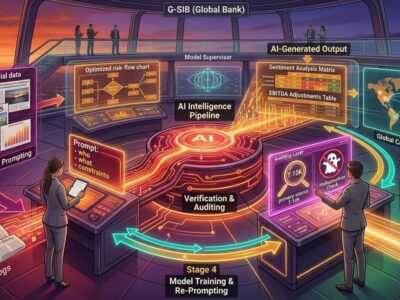
One of the most overlooked roles of AI in compliance is the use of Large Language Models (LLMs) for “Narrative Generation.” Every time a suspicious transaction is investigated, a human must write a detailed report for the regulators. This is a massive time sink for junior bankers. Modern AI tools can now ingest all the data points from an investigation and draft a high-quality, compliant narrative in seconds. The human analyst then simply reviews, edits, and signs off. This doesn’t just save time; it ensures a level of consistency across global offices that was previously impossible to achieve.
The Algoy Perspective
The real winner here will be the banks that master “Federated Learning.” This is a sophisticated AI technique where a model is trained across multiple institutions without actually sharing the underlying raw client data. This bypasses the stringent data privacy laws (like GDPR) that often prevent banks from collaborating on fraud detection. If you can learn from a fraud pattern detected at a bank in London to protect a branch in New York—without ever moving the data—you have created a global immune system for the financial grid.
However, we need a reality check. The biggest mistake firms are making right now is assuming that AI is a “plug-and-play” solution. Most G-SIBs are still struggling with messy, fragmented legacy data silos. You cannot build a high-performance AI engine on top of a “data swamp.” For the Associate-level banker, the career opportunity isn’t just in knowing how to use the AI; it is in understanding the data architecture that feeds it. If you can bridge the gap between the compliance department and the data engineering team, you become an indispensable asset.
While regulators like the SEC and the FCA are encouraging “innovation,” they are also terrified of “black box” models. They demand “Explainable AI” (XAI). If you cannot explain why the algorithm rejected a payment from a sovereign wealth fund, you are in for a regulatory nightmare. The future belongs to the “Augmented Analyst”—someone who uses AI to handle the heavy lifting of data processing but maintains the strategic oversight to justify those decisions to a regulator.