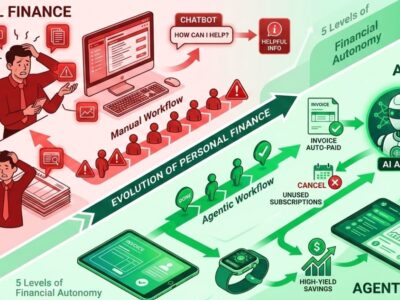

In the stock market, we are entering the era of the AI Trading Agent. This is a system that doesn’t just give you a signal but actually manages risk, places trades, and handles the “chores” of the market while you sleep.
Here is how AI Agents are transforming trading in India and how you can practically deploy one today.
🚀 The Evolution: Bot vs. Agent
To understand why this shift matters, you have to see the massive jump in intelligence between traditional automation and modern agents.
Key Differences at a Glance
| Feature | Traditional Trading Bot | AI Trading Agent |
|---|---|---|
| Logic | Static “If-Then” rules. (e.g., Buy if RSI < 30) | Dynamic reasoning. (e.g., Adjusts for volatility after RBI news) |
| Data | Price & Volume only. | 360° View. (News, Sentiment, & Macro feeds) |
| Action | Fires and waits. | Active monitoring. (Handles partial fills & live stop-losses) |
| Learning | Manual recalibration. | Self-optimizing. (Learns from slippage and history) |
🛠️ Practical Ways to Use AI Agents in India
Thanks to the SEBI Algorithmic Trading Framework, using these tools is now safer and more regulated for retail investors. Here is the blueprint for getting started:
1. Use “White Box” Broker APIs
Most major Indian brokers (Zerodha, Angel One, Sharekhan) now provide REST APIs.
- The Strategy: Use an AI agent (built in Python or via platforms like Composio) to connect to your broker.
- The Rule: As long as your agent places fewer than 10 orders per second, you generally don’t need complex “Algo Registration.” You just need a Static IP whitelisted by your broker for security.
2. AI-Driven “Sentiment Analysis”
Don’t let your agent just look at charts. The most successful agents use Natural Language Processing (NLP) to “read” earnings transcripts or SEBI circulars.
- The Tool: Use an agent to scan live news for keywords. If a “Black Swan” event occurs, the agent can trigger a Kill Switch to move your capital into liquid funds or gold instantly.
3. Automated “Tax-Loss Harvesting”
This is the ultimate “System over Chore” move.
- The Agentic Way: An agent monitors your portfolio for stocks in the red. It automatically sells them to offset capital gains and immediately buys a similar asset to maintain exposure—saving you lakhs in taxes with zero manual work.
🛡️ “Safety First” Guardrails (SEBI Rules)
Trading with AI is powerful, but SEBI has introduced strict Agentic Guardrails to protect you:
- Unique Algo-IDs: Every automated order is tagged with a unique identifier for full traceability.
- The Kill Switch: Your broker is mandated to provide a manual override. You can cut the agent’s power in one click.
- Broker Responsibility: Brokers act as “principals,” vetting the AI tools they allow on their platforms.
🏗️ How to Build Your First “Simple Agent”
You don’t need a PhD in Quant Finance. Follow this 3-step path:
- Get an API Key: Open your broker’s developer portal. Ensure you have a Static IP (provided by most ISPs for a small fee).
- Connect a “Reasoning Engine”: Use a platform like QuantConnect or Alpaca that allows you to plug in a Large Language Model (LLM). This gives your system the ability to “think” about market context.
- Paper Trade: Never go live on Day 1. Run your agent in a Sandbox for at least two weeks to ensure it handles volatility correctly.
💡 Conclusion: Automation is Your Edge
The “Lazy Investor” wins because they have a system. The Agentic Trader wins because they have a system that adapts. By automating execution and data-crunching, you free your mind to focus on what actually builds wealth: Strategy.