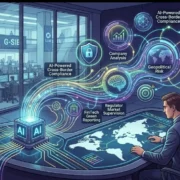


The traditional wealth management model of quarterly reviews and generic risk profiles is being replaced by a “Segment of One” approach where AI-driven hyper-personalization dictates client retention. For the modern financial professional, the value-add is shifting rapidly from manual portfolio construction toward the strategic synthesis of AI-generated behavioral insights.
The Shift from Reactive to Proactive Advisory
In the legacy banking world, wealth management was often a reactive game. A client’s life event—a liquidity event, a divorce, or a massive market swing—would trigger a conversation. Today, Global Systemically Important Banks (G-SIBs) are flipping this script. By integrating Large Language Models (LLMs) with proprietary client data, firms are now able to predict these life events before they happen.
We are seeing a move away from “rule-based” automation toward “probabilistic” intelligence. Instead of simply rebalancing a portfolio because it drifted 5% from its target, AI systems are analyzing external data—social media sentiment, localized real estate trends, and even subtle changes in spending patterns—to suggest bespoke investment themes. This isn’t just about efficiency; it’s about creating a level of “stickiness” that manual advisory cannot replicate.
G-SIB Case Studies: JPMorgan and HSBC
Leading the charge are institutions like JPMorgan Chase and HSBC, who have the capital to build proprietary ecosystems. JPMorgan’s development of IndexGPT is a prime example. Rather than relying on off-the-shelf software, they are building a tool designed to analyze and select securities based on thematic preferences. This allows junior analysts to move away from the “grunt work” of screening stocks and toward high-level strategy.
HSBC, on the other hand, has been leveraging AI to enhance its wealth insights in the Asia-Pacific region. By using machine learning to parse through massive datasets of client behavior, they can identify “latent needs”—products or services a client doesn’t know they need yet. For an associate-level banker, this means your “pitch book” is no longer a static PDF; it is a dynamic, AI-informed recommendation engine.
The Role of the Junior Analyst in the AI Era
As a junior analyst or associate, your job description is changing in real-time. The era of spending 14 hours a day in Excel is sunsetting. The new “Professional Edge” involves:
- Prompt Engineering for Finance: Learning how to query internal LLMs to extract specific risk factors from thousands of pages of annual reports in seconds.
- Sentiment Synthesis: Using AI tools to aggregate market sentiment across disparate regions to provide a localized “Alpha” perspective to senior MDs.
- Data Stewardship: Ensuring the data feeding these AI models is clean, compliant, and ethically sourced.
Efficiency Analysis: Traditional vs. AI-Augmented Wealth Management
The following table illustrates the operational shift we are observing within top-tier investment houses.
| Metric | Traditional Manual Advisory | AI-Augmented Advisory |
|---|---|---|
| Client Coverage Ratio | 1 Advisor per 30-50 Clients | 1 Advisor per 150-200 Clients |
| Portfolio Rebalancing Speed | 2-3 Days (Manual Approval) | Near Real-Time (Auto-Execution) |
| Risk/Error Rate | Moderate (Human Calculation Error) | Low (Algorithmic Precision) |
| Operational Cost | High (Man-hour Intensive) | Scalable (Low Marginal Cost) |
Overcoming the “Black Box” Challenge in Compliance
One of the biggest hurdles for junior professionals is explaining AI-driven decisions to compliance officers and regulators. In cross-border wealth management, especially between the US and the EU (where GDPR and the AI Act apply), “Explainability” is the new gold standard.
You cannot simply say, “The AI recommended this trade.” You must be able to trace the logic. Regulators like the FCA and SEC are increasingly looking at how banks manage “Model Risk.” For an associate, being the person who understands the “Explainable AI” (XAI) framework of your firm is a fast track to promotion. It bridges the gap between the black-box tech and the rigorous demands of banking compliance.
The Algoy Perspective
The real winner in the AI arms race will not be the firm with the fanciest chatbot, but the firm with the cleanest data lake. In our observation, the biggest mistake major banks are making today is layering expensive GenAI tools on top of messy, siloed legacy data. You can have the most advanced LLM in the world, but if your CRM data is fragmented across three different continents, the output will be hallucinated garbage.
While many articles suggest AI will replace junior bankers, the reality is more nuanced. AI will replace the *tasks* of the junior banker, but it will amplify the *influence* of those who know how to steer the machine. The “Reality Check” is that most firms are currently in a state of chaos, struggling with “hallucinations” in their internal models. The professionals who thrive will be those who can act as the “Human-in-the-loop,” verifying AI outputs and translating them into high-conviction advice for clients.
The biggest risk to your career isn’t AI—it’s your inability to speak its language. Stop worrying about Python coding and start focusing on data architecture and strategic prompt design. That is where the future of wealth management lies.
Sources and Further Reading
To stay updated on how global leaders are pivoting their AI strategies, refer to the official newsrooms of these institutions:
- JPMorgan Newsroom: https://www.jpmorganchase.com/newsroom
- HSBC News and Media: https://www.hsbc.com/news-and-media
- SEC Press Releases: https://www.sec.gov/news/pressreleases