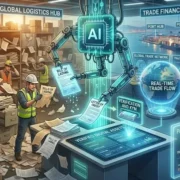


Global trade finance is shedding its reliance on centuries-old paper processes as Generative AI begins to orchestrate complex document verification and risk assessment in real-time. For junior analysts and associates, this shift represents a move away from manual data entry toward a high-level role focused on exception management and strategic liquidity advisory.
The End of the “Paper-Heavy” Era in Global Banking
For decades, trade finance has been the “ugly duckling” of digital transformation. While high-frequency trading and retail banking moved to the cloud, trade finance remained stuck in a world of physical Bill of Ladings, manual Letters of Credit, and couriers carrying envelopes across borders. In our observation, the sheer volume of unstructured data—stamps, signatures, and handwritten notes—made it nearly impossible for traditional “if-then” software to automate.
The real-world impact of Generative AI (GenAI) and Large Language Models (LLMs) is that they can finally “read” like a human. They don’t just look for text in a specific box; they understand the context of a trade contract. Major global banks are now deploying these tools to bridge the $2.5 trillion trade finance gap by making the process faster and less risky for small-to-medium enterprises (SMEs) that were previously deemed too expensive to audit manually.
How HSBC and JPMorgan are Leading the Charge
Tier-1 banks are not just experimenting; they are integrating AI into the core of their trade engines. These institutions manage trillions in trade flows, and even a 1% increase in efficiency translates to billions in unlocked liquidity.
HSBC’s Automated Document Checking
HSBC has been a frontrunner in utilizing AI to scan and verify trade documents against international standards (like the UCP 600). By using AI-driven optical character recognition (OCR) combined with NLP, they have drastically reduced the time it takes to check documents for discrepancies. This isn’t just about speed; it’s about reducing the “friction” that occurs when a shipment is stuck at a port because a comma was misplaced on a customs form.
JPMorgan’s Focus on Trade Fraud and AML
JPMorgan is leveraging AI to look beyond the text. Their systems analyze trade patterns to detect “red flags” that a human might miss—such as “ghost shipping” or “over-invoicing” used for money laundering. For a junior analyst, this means the AI does the “grunt work” of flag-generation, allowing the professional to focus on the high-level investigation of why a specific trade route looks suspicious.
The Workflow Shift: From Extraction to Insight
If you are a junior analyst today, your value no longer lies in your ability to compare two spreadsheets for eight hours. The “Professional Edge” now comes from your ability to manage the AI-human loop. We are seeing a transition where the analyst becomes the “Editor-in-Chief” of the bank’s data.
- Document Reconciliation: Instead of manually checking a Bill of Lading against a Sales Invoice, you will oversee an AI that flags only the 5% of documents that are non-compliant.
- Risk Profiling: AI can now ingest news feeds, weather reports, and geopolitical shifts to predict if a trade corridor is becoming risky. Your job is to translate that data into a credit recommendation.
- Hyper-Personalization: Using AI, analysts can now offer “Dynamic Discounting” to clients, providing better rates based on real-time supply chain performance rather than stale quarterly financials.
Efficiency Analysis: Traditional vs. AI-Augmented
| Factor | Traditional Trade Finance | AI-Augmented Trade Finance |
|---|---|---|
| Process Speed | 5 to 10 Days (Manual Review) | Minutes to Hours (Real-time) |
| Risk/Error Rate | High (Human fatigue/Oversight) | Low (Pattern recognition accuracy) |
| Operational Cost | High (Labor intensive) | Low (Scalable compute power) |
| Analyst Role | Data Entry & Comparison | Decision Making & Strategy |
Bridging the Gap: AI in Compliance and ESG
One of the most specific use cases emerging in global banking is the use of AI to track ESG (Environmental, Social, and Governance) compliance in supply chains. Regulators are increasingly demanding that banks prove their trade finance isn’t supporting “dirty” energy or unethical labor.
AI tools can now scrape satellite imagery and shipping manifests to verify that a “Green Trade Loan” is actually being used for sustainable goods. For junior professionals, mastering these “RegTech” tools is the fastest way to become indispensable. If you can explain to a senior MD how AI verifies the carbon footprint of a client’s shipping route, you are no longer just an analyst; you are a strategic asset.
The Algoy Perspective
The biggest mistake junior bankers are making right now is viewing AI as a “threat” to their headcount. The real threat isn’t the AI; it’s the peer who knows how to use the AI to do the work of five people. While the industry loves to talk about “seamless integration,” the reality is that most banks are currently struggling with massive data silos and “dirty data” that makes LLM implementation a nightmare.
The real winner in the next three years will not be the bank with the best algorithm, but the bank with the best “data hygiene.” As an associate, your move should be to lead the charge in data structuring. If you can help your desk clean up its legacy data so the AI can actually use it, you will have a front-row seat to the most significant shift in banking history. The “paper-pusher” is dead, but the “AI-orchestrator” is just getting started.