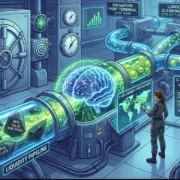


Artificial Intelligence is fundamentally shifting global treasury from reactive reporting to predictive liquidity management, allowing banks to optimize capital in real-time. For junior analysts, this means moving away from manual data aggregation and focusing on strategic cash positioning across fragmented global accounts.
In the world of global transaction banking, liquidity is the lifeblood of the economy. For years, junior analysts and treasury associates have spent their mornings performing the “Excel Dance”—downloading statement data from multiple portals, reconciling mismatched entries, and trying to predict end-of-day balances. It was a process defined by hindsight. By the time you finished the report, the data was already stale.
Today, the leading Global Systemically Important Banks (G-SIBs) are replacing these manual workflows with AI-driven predictive engines. This isn’t just about speed; it’s about the “cost of idle cash.” In a high-interest-rate environment, every million dollars sitting stagnant in a non-interest-bearing account is a missed opportunity for yield. AI allows banks to forecast exactly how much cash is needed in every jurisdiction, enabling them to sweep excess funds into overnight investments with surgical precision.
The Shift from Hindsight to Foresight
Traditional liquidity management relies on historical averages. If a corporate client usually pays their invoices on the 15th of the month, the model assumes they will do so again. However, AI looks deeper. Machine learning models can ingest thousands of variables, from macroeconomic shifts and shipping delays to the specific payment behavior of individual counterparties.
In our observation, the real value of AI in this niche is its ability to handle unstructured data. Global banks deal with a mess of legacy messaging formats. While ISO 20022 is standardizing things, many regions still rely on older, “noisier” data. AI models can now “read” these transaction descriptions, categorize them, and identify patterns that a standard spreadsheet formula would miss. This reduces the “noise” for analysts, allowing them to focus on true liquidity outliers rather than data entry errors.
Predictive Cash Positioning
The core of this technology is “Predictive Cash Positioning.” Instead of seeing what happened yesterday, analysts now see a “confidence interval” of what will happen over the next 30, 60, or 90 days. This allows the bank to manage its intraday liquidity much more aggressively.
For a junior professional, this changes your job description. You are no longer a data gatherer; you are a risk manager. You are looking at the AI’s predictions and deciding if the “tail risks”—those rare, high-impact events—are being accounted for. This is where human expertise meets machine efficiency.
Eliminating the “Buffer” Cost
Historically, banks kept a large “buffer” of cash to avoid the risk of falling below regulatory requirements or missing a payment. This buffer is expensive. AI minimizes the need for this safety net by providing higher certainty. When you can predict cash outflows with 98% accuracy, you can put that extra capital to work. This directly impacts the bank’s Return on Equity (ROE), which is a metric your senior MDs care about deeply.
Efficiency Analysis: Traditional vs. AI-Augmented
To understand the scale of this change, we can look at the operational metrics that define a treasury desk’s performance.
| Metric | Traditional Manual Process | AI-Augmented Workflow |
|---|---|---|
| Process Speed | 4-6 hours for daily reconciliation | Real-time continuous updates |
| Forecasting Accuracy | 70% – 80% (Historical average based) | 95%+ (Machine learning based) |
| Risk/Error Rate | High (Manual entry & Excel errors) | Low (Automated validation) |
| Operational Cost | High (Heavy headcount for data tasks) | Optimized (Focus on high-value analysis) |
How Analysts Can Leverage This Today
If you are an associate or a junior analyst, you might worry that “automation” means “replacement.” The real-world impact is actually the opposite. It frees you from the “grunt work” that leads to burnout. However, to stay relevant, you must pivot your skillset.
Mastering High-Velocity Data
The modern banker needs to understand the “pipeline.” You don’t need to be a data scientist, but you do need to understand how data flows from a SWIFT message into your bank’s AI model. Understanding the limitations of these models—such as “hallucinations” in predictive trends or data biases—makes you an invaluable asset to your team.
We suggest focusing on “Scenario Analysis.” Use the AI to run “What If” scenarios. What if a major regional bank goes offline? What if a specific currency devalues by 5%? Being able to present these AI-backed insights to your directors will set you apart from peers who are still stuck tweaking pivot tables.
The Algoy Perspective
The real winner in the AI liquidity race will not be the bank with the most sophisticated algorithm, but the bank with the cleanest data. The biggest mistake firms are making right now is throwing expensive AI tools at messy, siloed legacy data. It’s like putting a Ferrari engine in a horse-drawn carriage.
While the industry hype focuses on Generative AI and chatbots, the real “alpha” for global banks is in “Discriminative AI”—models that can classify, predict, and detect anomalies in transaction flows. For junior professionals, the “Reality Check” is this: AI will not save a bank with poor underlying infrastructure. If your bank’s data is siloed across 20 different geographical branches, no amount of AI magic will give you a clear liquidity picture.
The career move here is clear: align yourself with the projects that are breaking down these silos. Be the person who understands both the financial plumbing (liquidity, Basel III) and the digital architecture. That is the only way to remain “un-automatable” in the next five years.
Sources and Further Reading
To stay updated on how global leaders are implementing these shifts, monitor the official insights from these institutions: