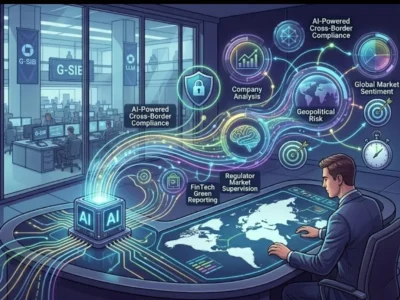


Global Tier-1 banks are shifting toward AI-driven “perpetual KYC” and real-time transaction monitoring. For bankers, this means a pivot from manual data entry to managing sophisticated machine learning models that can distinguish between a complex legitimate trade and a sophisticated money laundering scheme in milliseconds.
The Hidden Cost of Legacy Compliance
If you have spent any time in a compliance department at a global bank, you might already know the “false positive” headache. Traditional systems rely on rigid “if-then” logic. If a transaction exceeds $10,000 and originates from a specific high-risk jurisdiction, it gets flagged. The problem is that approximately 95% of these flags turn out to be harmless, forcing junior analysts to spend thousands of hours on manual investigations that yield nothing.
In the world of cross-border remittance, this friction is more than just an annoyance; it is a massive operational drain. Every time a payment is paused for a manual review, liquidity is trapped, and the customer experience suffers. Global institutions are now moving toward “Entity Resolution” powered by AI, which looks at the “who” rather than just the “what.” Instead of looking at a single transaction, the AI analyzes the entire network of relationships surrounding an account holder.
How AI Solves the Cross-Border Puzzle
The complexity of cross-border payments stems from differing regulatory standards across jurisdictions. A transaction moving from London to Singapore might pass through three different correspondent banks, each with its own risk appetite. AI-first RegTech (Regulatory Technology) is bridging this gap through several specific technical applications.
Graph Neural Networks (GNNs)
In our observation, the most significant breakthrough in AML (Anti-Money Laundering) is the implementation of Graph Neural Networks. Unlike traditional databases, GNNs map out connections. If Account A sends money to Account B, who then sends it to Account C, the AI can visualize these “hops.” This is particularly effective at catching “layering”—the process of moving money through various accounts to hide its origin. For an analyst, this means instead of looking at a spreadsheet, you are interacting with a visual map that highlights circular or suspicious flows automatically.
Natural Language Processing (NLP) for Sanctions Screening
Sanctions lists are messy. Names are spelled differently across languages, and “Pep” (Politically Exposed Person) lists are updated daily. NLP allows banks to move beyond simple keyword matching. It understands context, reducing the instances where a legitimate businessperson with a common name is flagged simply because they share a surname with a sanctioned individual.
Automated SAR Generation
Writing a Suspicious Activity Report (SAR) is one of the most time-consuming tasks for an associate. Generative AI is now being used to draft the initial narrative of these reports. The AI pulls data from the transaction history, the customer’s KYC profile, and external news sources to create a coherent summary. The analyst then acts as the final editor, ensuring the report is accurate before submission to regulators like FinCEN or the FCA.
Efficiency Analysis: Traditional vs. AI-Augmented
To understand why global banks are pouring billions into this transition, we need to look at the operational metrics. The following table compares the legacy approach to the AI-integrated workflow.
| Factor | Traditional Rule-Based Systems | AI-Augmented Compliance |
|---|---|---|
| False Positive Rate | 90% – 98% (High noise) | 30% – 50% (High precision) |
| Review Time per Alert | 45 – 90 Minutes | 5 – 10 Minutes |
| Operational Cost | Linear (More volume = More staff) | Scalable (Volume handled by compute) |
| Detection Capability | Known patterns only | Emerging “Zero-Day” patterns |
The Analyst’s New Toolkit: A Practical Workflow
For the junior analyst or associate-level banker, the value proposition is shifting. You are no longer a “check-the-box” operator. To advance in this environment, you need to master the interface between banking intuition and machine output.
- Model Interpretability: You must understand why a model flagged a transaction. Regulators do not accept “the AI said so” as a valid reason. You need to be able to explain the features (variables) the model used to reach its conclusion.
- Data Orchestration: The real-world impact of AI often hits a wall due to data silos. Learning how to query data across different regional branches using basic SQL or Python can make you ten times more effective than an analyst waiting for a manual data pull.
- Feedback Loops: AI learns from your decisions. When you mark an alert as “false positive,” the system gets smarter. Understanding the feedback loop between human intuition and machine learning is the core of modern compliance.
The Algoy Perspective
We believe that, the beneficiaries will be the institutions that stop treating compliance as a back-office “cost center” and start seeing it as a competitive advantage. If a bank can clear cross-border transactions in minutes while its competitor takes 48 hours due to manual AML checks, the faster bank wins the corporate treasury business every time.
However, the biggest mistake firms are making is assuming AI is a “set and forget” solution. There’s a reality check that most banks still struggle with messy legacy data silos that make AI implementation a nightmare. While the models are powerful, they are only as good as the data fed into them. For the banking professional, the opportunity lies in being the person who can bridge the gap between “dirty data” and “clean AI insights.” The future of compliance isn’t about finding the needle in the haystack; it’s about using AI to burn the haystack so only the needle remains.
Sources and Further Reading
- JPMorgan Chase Newsroom: https://www.jpmorganchase.com/newsroom
- UK Financial Conduct Authority (FCA) News: https://www.fca.org.uk/news