

Artificial Intelligence is no longer a luxury for international treasury; it is the essential infrastructure required to bypass legacy correspondent banking delays. For the modern analyst, mastering these AI-driven AML and KYC workflows is the fastest way to bridge the gap between back-office operations and strategic front-office value.
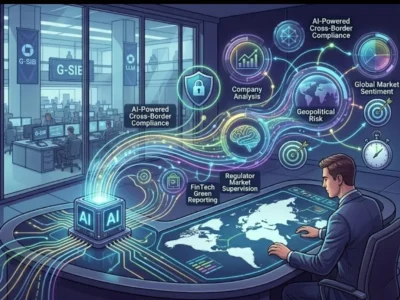
The traditional correspondent banking model is dying. For decades, moving money across borders involved a fragmented chain of intermediary banks, each with their own manual compliance checks, time-zone delays, and “fat-finger” data entry errors. This “black box” of international finance has been the primary source of friction for global liquidity. Today, Global Systemically Important Banks (G-SIBs) are leveraging AI to transform this friction into a competitive advantage.
In our observation, the shift isn’t just about speed; it’s about intelligence. When a payment moves from London to Singapore, it must pass through a gauntlet of Anti-Money Laundering (AML) and Know Your Customer (KYC) protocols. Historically, this meant a high rate of “false positives”—legitimate transactions flagged as suspicious—which required manual intervention from junior analysts. AI-first compliance is changing the math.
The Rise of Graph Analytics in AML
Major players like HSBC and JPMorgan are moving away from linear database searches toward graph-based AI models. Traditional systems look at individual transactions in isolation. If a client sends $49,999 to a high-risk jurisdiction, a rule-based system flags it. However, AI-driven graph analytics look at the entire network of relationships.
By mapping connections between entities, addresses, and transaction histories, AI can identify “layered” transactions that manual reviewers would miss. For an associate-level banker, this means the focus is shifting from “ticking boxes” to analyzing the complex behavioral patterns generated by the AI.
HSBC, for instance, has integrated AI to process millions of transactions across its global network, identifying sophisticated financial crime patterns that were previously hidden in the noise of global trade. This isn’t just about catching “bad actors”; it is about reducing the operational drag that costs banks billions in annual overhead.
Solving the KYC Data Silo Problem
The biggest headache in cross-border finance is the inconsistency of data. A corporate client in Germany provides different documentation than a subsidiary in Brazil. AI-powered Natural Language Processing (NLP) is now being used to extract, normalize, and verify this data across different languages and regulatory frameworks.
Instead of an analyst manually comparing a PDF of a business license to a government registry, AI agents perform these checks in seconds. This allows banks to onboard multinational clients in days rather than months. For the junior professional, the “value-add” is no longer in gathering the data, but in interpreting the risk score the AI provides.
Efficiency Analysis: Traditional vs. AI-Augmented Compliance
To understand the scale of this shift, we must look at the operational metrics that drive bank profitability.
| Factor | Traditional Manual Process | AI-Augmented Process |
|---|---|---|
| Process Speed | 24–72 Hours (T+2/3) | Near Real-Time (Seconds/Minutes) |
| False Positive Rate | 95% – 98% (High manual noise) | Under 15% (High precision) |
| Operational Cost | High (Scales linearly with headcount) | Low (Scales with compute power) |
| Data Interoperability | Low (Siloed by region) | High (Global unified view) |
The “Professional Edge”: How to Leverage These Tools
If you are a junior analyst or associate, the arrival of these tools is your biggest opportunity. The banks that are winning—JPMorgan with its Onyx platform or Goldman Sachs with its automated transaction banking—are looking for “AI-fluent” professionals.
The real-world impact is that you are no longer expected to be a data entry clerk. You are expected to be a risk strategist. Understanding how an AI model arrives at a “risk score” is more important than knowing how to fill out a KYC form. Analysts who can bridge the gap between the technical output of an AI model and the practical needs of a corporate client will be the ones promoted to VP and Director roles.
The Algoy Perspective
The biggest mistake firms are making is viewing AI as a “cost-saving” tool for the back office. At Algoy, we see it as a front-office revenue generator. The real winner here will be the banks that use AI-driven compliance to offer “Instant Cross-Border Liquidity” as a premium service.
While AI is powerful, most banks still struggle with messy data silos that make implementation a nightmare. The legacy architecture of core banking systems was never designed for real-time AI processing. Therefore, the “holy grail” of global banking isn’t just a better algorithm; it is the interoperability between these AI models and the aging ledger systems they sit on top of.
For the aspiring finance leader, the focus should not be on “learning to code,” but on understanding the mechanics of automated risk. The friction in cross-border payments is disappearing, and with it, the traditional roles that managed that friction. Adapt now, or be left behind in the manual era.
Sources and Further Reading
JPMorgan Newsroom: https://www.jpmorganchase.com/newsroom
HSBC News and Media: https://www.hsbc.com/news-and-media