

The transition from rules-based compliance to AI-driven network analytics is fundamentally changing how global banks manage risk and cross-border transactions. For bankers, understanding this shift is the difference between being a manual data processor and a strategic risk architect in the modern financial landscape.
Traditional Anti-Money Laundering (AML) systems operate on rigid logic: if a transaction exceeds $10,000 or originates from a specific geography, flag it. The result? A staggering 95% of alerts are often “noise,” forcing bankers to spend hours manually clearing transactions that were never a threat to begin with.
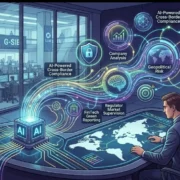
Today, the world’s largest banks, or Global Systemically Important Banks (G-SIBs), are moving away from these binary triggers. Leading institutions like HSBC and JPMorgan are deploying sophisticated AI models that don’t just look at a single transaction but analyze the entire context of a customer’s behavior and their global network of connections. This is not just a technical upgrade; it is a total overhaul of the banking defense mechanism.
The Evolution from Rules to Reasoning
Traditional systems are reactive. They wait for a rule to be broken. AI-driven compliance, however, is predictive and contextual. It uses “Entity Resolution” to link disparate data points—an address in London, a phone number in Dubai, and a shell company in the BVI—to reveal the hidden “UBO” (Ultimate Beneficial Owner).
We believe that, the real-world impact is most visible in how banks handle sanctions screening. When a new entity is added to a global sanctions list, AI can instantly scan millions of historical records to find “fuzzy matches” or phonetic similarities that traditional systems would miss. For a banking professional, this means your role is shifting from “finding the needle” to “interpreting why the needle is there.”
How HSBC is Leading the Charge
HSBC has been a pioneer in integrating network analytics into their financial crime framework. By partnering with specialist AI firms, they have moved toward a “holistic view” of risk. Instead of looking at a single account, their AI identifies “clusters” of activity. If five accounts show similar patterns of rapid-fire transfers followed by immediate withdrawals, the AI flags the entire cluster as a potential money-laundering ring.
This approach reduces the workload for junior analysts by filtering out the low-risk noise. However, it also raises the bar for what an analyst needs to know. You no longer just check boxes; you must understand how a machine-learning model reached its conclusion and be able to explain that logic to a regulator.
Efficiency Analysis: Traditional vs. AI-Augmented
To understand why global banks are spending billions on this transition, we need to look at the operational reality. The following table breaks down the performance gap between legacy frameworks and AI-integrated systems.
| Feature | Traditional Rules-Based System | AI-Augmented Compliance |
|---|---|---|
| Process Speed | Manual review can take 24-48 hours per flagged case. | Near-instant screening with real-time risk scoring. |
| Risk/Error Rate | High (90%+ false positive rates are common). | Low (Significant reduction in noise, higher detection of actual crime). |
| Operational Cost | High (Requires massive teams of “level 1” analysts for manual clearing). | Medium-High (Higher tech spend, but lower long-term human capital cost). |
| Scalability | Difficult; requires more headcount as transaction volume grows. | High; models handle increased volume without linear cost increases. |
The Role of Regulators: From SEC to the FCA
Regulators are no longer skeptical of AI; they are becoming its biggest advocates. The Financial Conduct Authority (FCA) in the UK has been running “TechSprints” to encourage the use of privacy-enhancing technologies (PETs) and AI in fighting financial crime. They realize that criminals are already using AI to find loopholes, so banks must use AI to close them.
For an associate-level banker, this means regulatory compliance is becoming a data science discipline. When the SEC or FCA audits a bank today, they aren’t just looking at your files; they are looking at your algorithms. They want to see that your AI is “explainable”—meaning you can prove the model isn’t biased and that it actually understands the risks it is flagging.
The Career Edge: How to Leverage This
If you are an analyst today, the best way to “future-proof” your career is to bridge the gap between finance and data. You don’t need to be a Python expert, but you must be “AI-literate.” This means understanding how data flows from a core banking system into a risk model and knowing how to interpret a “Risk Score.”
- Master Querying: Learn how to ask the right questions of the data. If the AI flags a transaction, look for the “features” (variables) that triggered it.
- Understand Explainability: In every meeting, ask: “Can we explain this model’s decision to a regulator?” This is the #1 concern for senior management.
- Network Beyond Finance: Start talking to the data engineers in your firm. They are the ones building the tools you will be using for the next decade.
The Algoy Perspective
The real winner here will be the banks that successfully break down their internal data silos. Currently, many G-SIBs are trying to run advanced AI on top of “messy” legacy infrastructure where the retail data doesn’t talk to the investment banking data. This is a recipe for failure. The biggest mistake firms are making is assuming that buying an AI tool will solve their problems without first fixing their underlying data architecture.
While AI is incredibly powerful, it is only as good as the data it consumes. We are seeing a massive “reality check” where banks realize that 80% of an AI project is actually just data cleaning. For the junior analyst, this is an opportunity. If you can be the person who understands the data lineage—where the data comes from and what it actually represents—you become indispensable. The future of banking isn’t just about moving money; it’s about the intelligent management of the information surrounding that money.
Sources and Further Reading
- HSBC Newsroom: https://www.hsbc.com/news-and-media
- FCA (UK) News: https://www.fca.org.uk/news