

Global trade finance is shedding its legacy of paper-based delays as AI-driven dynamic risk scoring transforms how G-SIBs evaluate creditworthiness across borders. For junior analysts and associates, mastering these automated underwriting workflows is no longer optional; it is the baseline for moving from manual document checking to high-level strategic portfolio management.
The Friction in Traditional Trade Finance
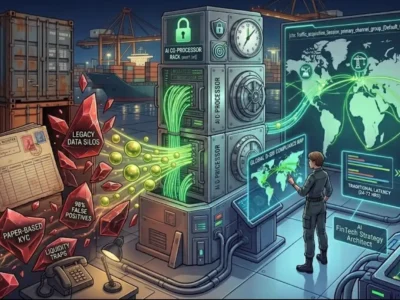
For decades, trade finance has been the “paper-heavy” dinosaur of the banking world. If you are an analyst in a trade desk today, you likely spend a significant portion of your time reviewing bills of lading, invoices, and certificates of origin. This manual process is not just slow; it creates massive liquidity traps. When a shipment is stuck at a port because of a typo in a letter of credit, capital is sidelined.
In our observation, the industry is reaching a tipping point. Major global systemically important banks (G-SIBs) are no longer treating AI as a back-office experiment. They are integrating it directly into the “middle office” to handle risk assessment in real-time. This shift is particularly visible in trade hubs like Singapore, London, and New York, where transaction volumes demand a speed that human eyes simply cannot match.
How AI-Driven Dynamic Risk Scoring Works
The core of the “AI revolution” in trade finance lies in dynamic risk scoring. Traditional credit scoring relies on historical financial statements, which are often months or even years out of date. In the volatile world of cross-border trade, a company’s risk profile can change in a week due to geopolitical shifts or supply chain disruptions.
Natural Language Processing (NLP) in Document Verification
Modern AI systems use NLP to scan thousands of unstructured documents. Instead of an associate manually checking if a bill of lading matches an invoice, AI does it in seconds. More importantly, it flags anomalies that suggest fraud or “double invoicing,” which are historically difficult for human reviewers to catch in high-volume environments.
Predictive Analytics for Default Risk
By layering external data—such as satellite imagery of port congestion, fuel price fluctuations, and real-time shipping data—AI models can predict potential defaults before they happen. For a junior analyst, this means your role is shifting from “data gatherer” to “decision maker.” You are no longer the one finding the data; you are the one interpreting the AI’s “red flag” and deciding whether to freeze a credit line.
Efficiency Analysis: Traditional vs. AI-Augmented
To understand the scale of this shift, we must look at the operational metrics. The following table illustrates the performance gap between legacy manual processes and the new AI-integrated workflows being adopted by firms like HSBC and JPMorgan.
| Metric | Traditional Manual Process | AI-Augmented Workflow |
|---|---|---|
| Document Processing Time | 24 to 72 hours | Seconds to Minutes |
| Risk/Error Rate | High (Human oversight fatigue) | Low (Algorithmic consistency) |
| Operational Cost | High (Labor intensive) | Scalable (Low marginal cost) |
| Data Refresh Frequency | Quarterly/Annual | Real-Time/Daily |
The Regional Impact: Singapore and London Lead
The real-world impact is most visible in jurisdictions with strong regulatory support for “FinTech-first” banking. In Singapore, DBS has been a pioneer in using AI to provide trade financing to SMEs that were previously deemed “unbankable” due to a lack of traditional credit history. By analyzing transaction flows rather than just balance sheets, AI allows the bank to extend liquidity with high confidence.
In London, banks are using AI to navigate the post-Brexit regulatory landscape. AI compliance tools now automatically map trade flows against evolving sanctions lists, ensuring that no trade crosses a prohibited border. For associates in these regions, the career trajectory is clear: those who understand how to audit and manage these AI models are being fast-tracked into leadership roles.
Practical AI Workflows for the Modern Analyst
If you are a junior analyst looking to stay relevant, you need to change how you interact with bank data. You should focus on these three areas:
- Anomaly Detection Mastery: Learn how to interpret why an AI model flagged a specific trade as “high risk.” Is it a geopolitical trigger, or a pattern of shell company behavior?
- Data Visualization: Move away from static spreadsheets. Start using tools like Tableau or PowerBI to present AI-generated risk scores to credit committees.
- Prompt Engineering for Financial Research: Use internal AI sandboxes to summarize thousands of pages of trade regulations or country-specific risk reports instantly.
The Algoy Perspective
We think that the real winner here will be the banks that stop viewing AI as a “cost-saving tool” and start viewing it as a “revenue engine.” By reducing the friction in trade finance, banks can capture a larger share of the global trade market.
The biggest mistake firms are making is assuming that AI replaces the need for human judgment. In reality, while AI is incredibly powerful at pattern recognition, most banks still struggle with messy data silos that make implementation a nightmare. Legacy systems often don’t “talk” to the new AI modules, leading to fragmented risk views.
The reality check is this: AI won’t take your job, but an associate who knows how to leverage AI to manage 10x the portfolio volume you do certainly will. The future of trade finance isn’t about knowing the rules of UCP 600 by heart; it’s about knowing how to manage the algorithms that enforce those rules.