


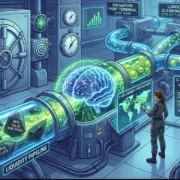
The rapid evolution of real-time payment rails and digital banking has turned liquidity management into a high-stakes, intraday game where manual forecasting no longer suffices. For junior analysts and associates, mastering AI-driven predictive modeling is the only way to manage the “velocity of money” that now defines global treasury operations.
In our observation at Algoy, the collapse of several mid-sized institutions in early 2023 served as a brutal wake-up call for the entire banking sector. It proved that in the age of social media and instant transfers, a bank run can happen in hours, not days. This has pushed Global Systemically Important Banks (G-SIBs) to move beyond static, historical data and toward live, AI-augmented liquidity buffers.
The Shift from Reactive to Predictive Treasury
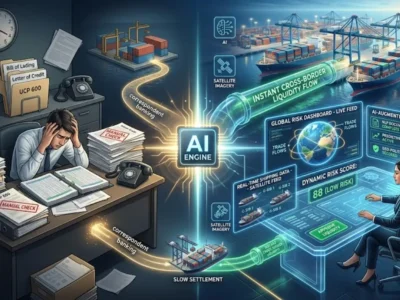
For decades, liquidity management was a back-office function focused on “T+1” (tomorrow plus one) reporting. You looked at what happened yesterday to guess what might happen today. This reactive stance is a legacy of fragmented data silos where the retail side of the bank didn’t talk to the institutional side in real-time.
Today, the leading global banks are implementing machine learning models that ingest thousands of variables simultaneously. These models don’t just look at internal balance sheets; they analyze geopolitical sentiment, interest rate swap volatility, and even consumer behavior patterns. The goal is simple: predict a liquidity squeeze before the market even feels it.
Why Junior Analysts Must Adapt
If you are an analyst in a Treasury or Risk function, your value-add is no longer in “cleaning the spreadsheet.” AI tools now handle the ingestion of unstructured data. Your new role is to act as the “model supervisor.” You need to understand why the AI is flagging a potential liquidity gap in a specific currency corridor, such as the EUR/USD swap market, and whether that flag is a genuine risk or a data anomaly.
How Major Banks are Leading the AI Charge
Global giants like JPMorgan and HSBC are not just experimenting with AI; they are embedding it into their core clearing and settlement engines. In our observation, the most successful implementations are those that solve the “friction” of cross-border settlements.
JPMorgan has been vocal about its use of AI to optimize intraday liquidity, reportedly saving millions in capital costs by reducing the “idle” cash that needs to be held in reserve. By predicting exactly when a major corporate client will execute a multi-billion dollar payment, the bank can keep its capital working in higher-yield environments for longer.
HSBC has similarly integrated AI into its global liquidity and cash management portals. This allows corporate treasurers to see not just where their money is, but where it *will be* based on historical transaction cycles. This “predictive visibility” is becoming a standard expectation for tier-one banking clients.
Efficiency Analysis: Traditional vs. AI-Augmented
To understand the scale of this transformation, we must look at the operational metrics. The following table highlights the stark contrast between legacy treasury management and the new AI-first approach.
| Factor | Traditional Methods | AI-Augmented Systems |
|---|---|---|
| Process Speed | Batch processing (End-of-Day) | Streaming analytics (Real-time) |
| Risk/Error Rate | High (Subject to human bias and manual entry) | Low (Algorithmic consistency and pattern recognition) |
| Operational Cost | High (Requires large teams for manual reconciliation) | Scalable (Initial high dev cost, but low marginal cost) |
| Forecasting Accuracy | Linear extrapolation of past trends | Non-linear, multi-variable predictive modeling |
The Role of Reinforcement Learning
One of the more advanced techniques we see emerging is Reinforcement Learning (RL). Unlike standard AI that looks for patterns, RL “trains” an agent to make a series of decisions to achieve a goal—in this case, maintaining the optimal liquidity ratio. The RL agent “simulates” thousands of market stress scenarios, learning how to rebalance portfolios in milliseconds when liquidity begins to dry up in specific sectors.
The Algoy Perspective
The real-world impact of AI in liquidity is often misunderstood. Most commentators focus on “automation,” but the real winner here will be the banks that use AI to achieve **Capital Elasticity**.
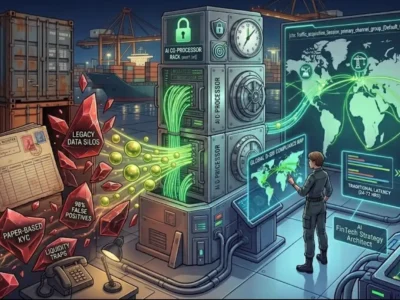
The biggest mistake firms are making is trying to layer AI on top of “messy” legacy systems. If your underlying data architecture is a “spaghetti bowl” of 20-year-old COBOL code, your AI will simply produce “fast garbage.” At Algoy, we believe the strategic advantage will shift toward banks that have the courage to undergo “core banking replacement” rather than just adding “AI patches.”
While AI is incredibly powerful, the reality check for every junior analyst is this: AI cannot account for “Black Swan” events that have no historical precedent. The machines are great at predicting the “known unknowns,” but they are blind to the “unknown unknowns.” Your career edge lies in being the human who can intervene when the AI’s logic fails to account for a geopolitical shock that hasn’t happened in the last 50 years.
Practical Steps for Your Career
If you want to stay relevant in this environment, you need to bridge the gap between “Finance” and “Data Science.” You don’t need to be a Python developer, but you must be “AI Literate.”
- Learn the basics of SQL and how data flows through a bank’s ledger.
- Understand the difference between “Supervised” and “Unsupervised” learning in a risk context.
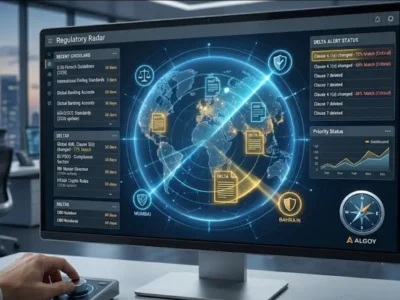
- Stay updated on Basel III/IV liquidity requirements (LCR and NSFR), as these are the “rules” the AI is being programmed to follow.
The future of banking isn’t just about having the most capital; it’s about having the most “intelligent” capital. As a junior professional, being the bridge between the algorithm and the executive suite is the most secure position you can hold.








[…] fastest banks use real-time data pipelines and predictive liquidity management systems that pre-stage stress scenarios and aggregate data continuously, not batch-at-close. But these […]